Works at Parklaan reveal historic quay wall
29 dec 2025, 15:43 • News in English
Gemeente Sittard-Geleen
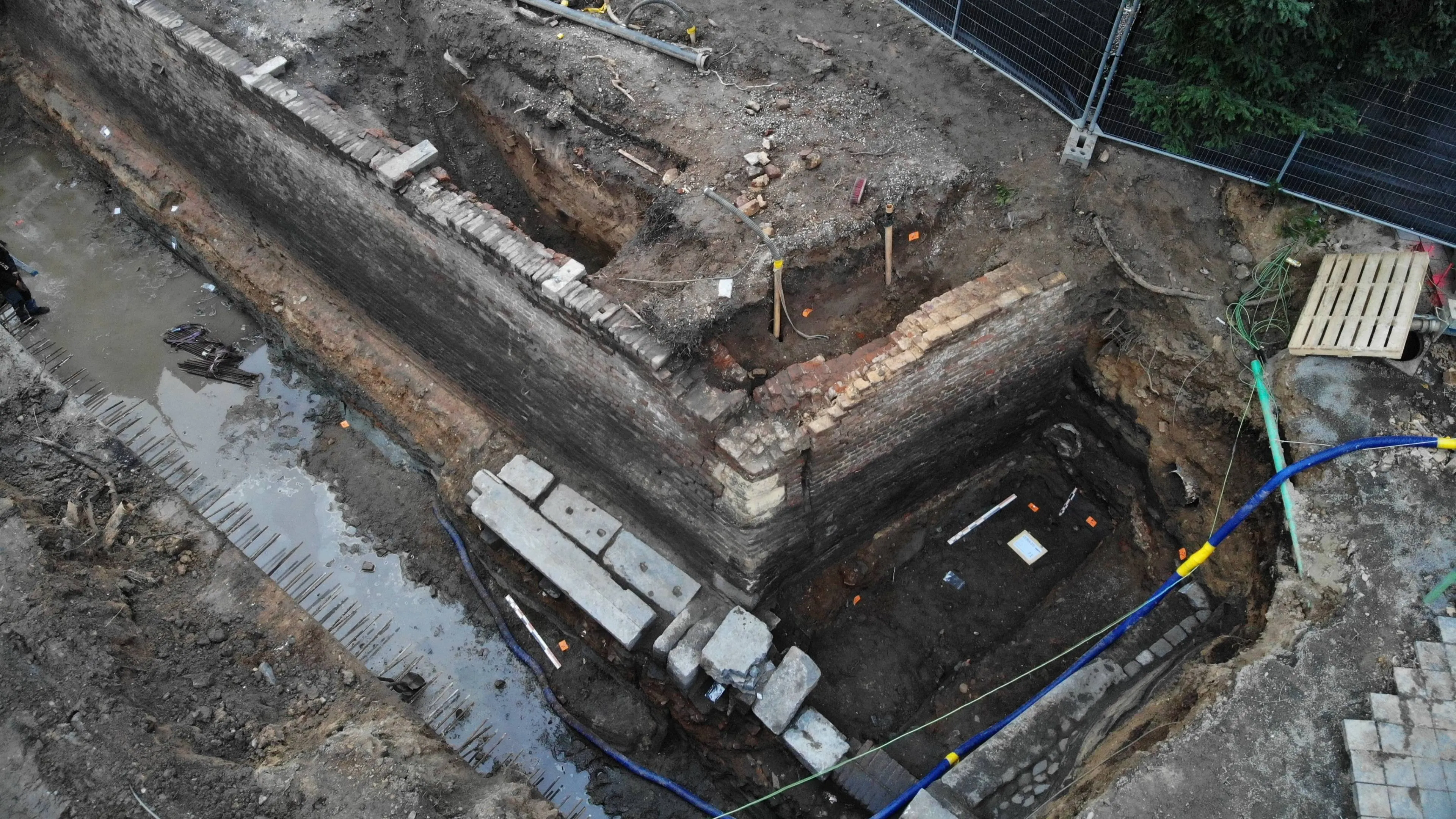
Links kademuur-rechts zuidelijke wand hellingbaan-onder hardstenen platform
Sittard - During the redevelopment works of the Geleenbeek at Parklaan in Sittard, a historic quay wall has been uncovered.
This remarkable discovery once again highlights the longstanding significance of water within the city.
Works
Currently, Waterschap Limburg and the Municipality of Sittard-Geleen are working on the daylighting of the Geleenbeek (known as the Keutelbeek in this section) at Parklaan. This redevelopment in the centre of Sittard is part of the overall development plan “Corio Glana” for the Geleenbeek valley. By designing the brook and valley to be spacious and climate-resilient, an attractive green corridor is created through the city. This development helps to tackle climate-related challenges such as flooding, drought, and heat stress in the urban area, while also restoring the brook to the streetscape.
“The discovery of the historic quay wall makes it immediately clear how wonderful it is for the water to be visible again, as it emphasises that this is the brook’s natural place. In this way, future and past beautifully converge at this historic site,” said Chief Executive Leon Geilen.
“The opening up of the brook highlights the green-blue connection from the city park to the historic city centre. The fact that we are also contributing to reducing waterlogging in the neighbourhood is a major benefit,” explained Josette Van Wersch, member of the daily board of Waterschap Limburg.
The historic quay wall
Research into the wall is not yet complete, but an initial inspection by archaeologist Willem-Simon van de Graaf has already provided valuable insights. The wall is nearly 3 metres high and runs alongside Parklaan, turning towards Voorstad. In the past, this location featured a ramp down to the brook, leading to a washing and watering place. The upper brick layer was probably constructed around 1904.
Beneath the top layer, masonry can be seen that is only slightly older (19th century). The lower half of the wall shows evidence of multiple repairs and different, older phases of construction. At the back and in the foundation, it is clear that the original quay wall is at least 400 years old.
The Middle Ages
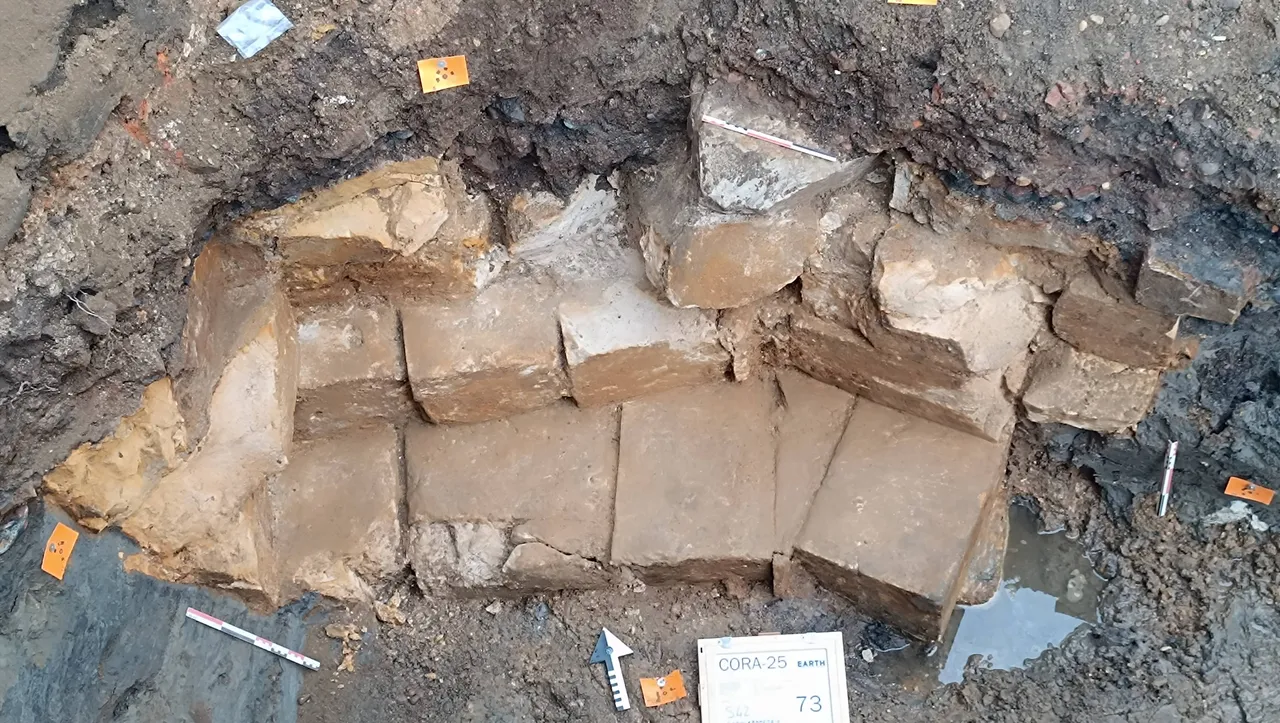
Alongside the quay wall, at a low level, there was a kind of platform made from large hardstone blocks of various sizes. These are reused building elements, likely originating from a substantial structure. The blocks have been carefully salvaged and are now stored so that they can be reused in the area’s redevelopment. Beneath the foundations of the ramp, remains of an impressive structure built from large marl blocks were found.
This construction predates the ramp and possibly dates back to the Middle Ages. As only a small part could be exposed, its function remains unclear. It could be a bridge pier or an older quay wall.
What will happen with the discovered quay wall is still undecided. However, it was previously determined that a staircase will be built where the former ramp was, leading down to the brook. This will restore access to the water at this particular historic location. The intention is to make the historic quay wall as visible as possible once again.
Brook and city inextricably linked
Chief Executive Andries Houtakkers spoke about the significance of the find: “The walls and the remnants of the ramp make the historic use of the brook in recent history clear. They provide an important piece of the puzzle in the story of the brook. Everywhere along the brook we find traces from the past, reaching back to the first settlements in Limburg some 7,000 years ago and now to our most recent history.”
There are also finds from all other major historical periods, such as Roman times and the Middle Ages. Water is the link, the constant factor through the ages. The use of water adapts to changing needs and shifting perspectives. The fact that we are now opening up the brook after it was covered for decades is another example of this.”
Chief Executive Leon Geilen adds: “You can see that a project like this does not stand on its own. We are, in a sense, writing the next chapter in the story of the brook, respecting its natural functions, its role in the water cycle, and its history.”
Gemeente Sittard-Geleen
Kademuur fors fundament van mergelblokken van voren -zuid-ingezoomd
♦♦♦
Als extra service
worden, in samenwerking met Buddy System
Sittard-Geleen, nieuwsberichten vertaald voor de vele expats in de
gemeente.
As an extra service, in cooperation with Buddy System Sittard-Geleen, local news is being translated for the many expats living in
Sittard-Geleen and surroundings.
♦♦♦
· Stay informed via Facebook, X or via the newsletter, you can also subscribe at
the bottom of this page.
· Submit a local (press)
release or event? You can do so via [email protected] .
Want to advertise on Sittard-Geleen.nieuws.nl? Visitor numbers continue to rise, which is good for the visibility of our
advertisers, among other things. Do you want to increase your brand awareness?
We are happy to help you think about how to spend your advertising euros as
optimally as possible. By advertising locally on Sittard-Geleen Nieuws at a
competitive price! Contact Paul Storms by phone: 06-22543972 or by email: [email protected] .
The news desk can be reached via [email protected].

Loading articles...
Loading